
Wireless Warriors
Wireless Warriors: Decoding India’s Telecom Saga

1. Introduction to India's Telecom Landscape

The Indian telecom landscape has undergone a remarkable transformation. It has transitioned from a state-controlled monopolistic industry to a competitive and thriving industry. Technological advancements, policy reforms, and the emergence of major players have led to this evolution. Let’s delve into the historical overview of the sector, the liberalization in the 1990s, and the pivotal contributions of major telecom operators.

Historical Overview of the Indian Telecom Sector

In the 1990s, something incredible happened in India that changed the way we connect with each other – the telecom revolution. Before that, having a telephone was a luxury enjoyed by only a few. But when the 1990s rolled around, things started to change. The Indian government decided to open up the doors to private companies in the telecom world.

This decision with National Telecom Policy 1994 gave birth to a wave of new telecom players entering the scene. Names like Spice Communications, Escotel, and Hutch Essar became familiar. These companies weren’t just new players; they were the pioneers of mobile communication. They set the stage for what we now call our mobile phones.

Among them, Bharti Airtel became a household name, offering mobile services to people across the country. Reliance Communications, Tata Indicom, and Aircel joined in, adding their own colors to this vibrant landscape. Vodafone and Idea Cellular stepped in, expanding the reach of mobile networks and services even further.

This era marked the start of the telecom journey that shaped our lives. From luxury to necessity, from wired phones to wireless connections, the 1990s set the wheels in motion. The Indian telecom sector transformed from being a privilege of a few to an essential part of our daily lives, connecting us in ways we could never have imagined.

Emergence and Contributions of Major Telecom Operators

The major telecom operators collectively transformed India’s communication landscape:

  • Modi-Telstra

    The first mobile phone call was made on July 31, 1995 between Union Telecom Minister Sukh Ram and the then Chief Minister of West Bengal, Jyoti Basu, on the network of Modi Telstra. After the fallout between the Indian partners BK Modi Group and Australian telecom giant Telstra, the service in Kolkata was sold to Airtel.

  • Spice Communications

    It was an early entrant into the Private telecom landscape in India, and played an important role in the early mobile connectivity in Punjab and Karnataka. It was later merged with Idea Cellular Limited.

  • BPL Telecom

    It was also an early player in the mobile industry history of India. It was later rebranded to Loop mobile in 2009, and ceased operations in 2014 after the expiry of its licence in Mumbai.

  • Escotel

    Emerged in 1996, contributed to the growth of mobile services. Merged into Idea Cellular.

  • Hutch Essar

    Established in 1999, contributed to the mobile revolution. Acquired by Vodafone to become Vodafone India.

  • Bharat Sanchar Nigam Limited (BSNL)

    Founded in 2000, BSNL expanded landline and mobile services, especially in remote areas.

  • Tata Indicom

    It also operated on CDMA technology and brought data services to Indian consumers in early 2000s.

  • Vodafone

    Entered Indian market, offering mobile and data services. Later merged with Idea Cellular in 2018.

  • Idea Cellular

    It was one of the prominent players in the mobile industry, and played a significant role in providing mobile services and data connectivity in the rural and urban regions.

  • Aircel

    Contributed to the expansion of mobile services in India.

  • MTNL

    Established in 1985, offered landline and mobile services primarily in Mumbai and Delhi.

  • Videocon

    Introduced mobile services, contributing to the increasing mobile user base.

These telecom players, each with their unique contributions, laid the foundation for India’s remarkable telecom growth during the 1990s and 2000s. They bridged communication gaps and connected people across the nation, reshaping the way we communicate. 


2. Factors driving the rise of Major Telecom Players:

In the dynamic landscape of the telecommunications industry, the rise of major players can be attributed to a combination of strategic decisions, innovative offerings, global partnerships, expansive network strategies, and technological advancements. These factors have propelled the growth of telecom giants, creating a transformative impact on the sector.

Early Market Entry: Strategic Advantage as Early Entrant

Bharti Airtel, one of India’s leading telecom players, gained a significant edge by being an early entrant into the market. During the 1990s, when the Indian telecom sector was liberalized, Bharti Airtel seized the opportunity and established itself as a pioneer. This early start allowed the company to build a strong foundation, infrastructure, and customer base ahead of its competitors. By establishing a foothold before the market became saturated, Bharti Airtel was well-positioned to capitalize on the growing demand for communication services.

Innovative Service Offerings: Introduction of Value-Added Services and Their Impact

The introduction of innovative value-added services (VAS) played a pivotal role in driving the success of major telecom players. These services went beyond traditional voice calls and SMS, enhancing the user experience and adding value. For instance, services like caller tunes, mobile banking, and entertainment packages were introduced. These offerings not only generated additional revenue streams but also attracted a diverse range of customers. VAS personalized the telecom experience, making it more engaging and relevant to users’ lifestyles.

Global Collaborations: Partnerships with International Telecom Giants

Global collaborations played a crucial role in shaping the trajectory of major telecom players. Partnerships with international giants brought expertise, technology, and investment into the Indian market. Vodafone’s acquisition of Hutchison Essar (now Vodafone Idea) showcased the significance of global partnerships. These collaborations not only expanded the players’ reach but also infused the market with international best practices and innovation.

Network Expansion Strategies: Extensive Reach, Rural Penetration, and Customer Acquisition

A key factor behind the rise of major telecom players was their strategic network expansion. Bharti Airtel, in particular, focused on building an extensive network that reached both urban and rural areas. This aggressive approach allowed them to penetrate previously underserved regions, connecting millions of previously isolated individuals. The focus on rural penetration aligned with government initiatives like Digital India, fostering inclusive growth and bridging the digital divide. Idea Cellular’s focus to have a strong hold on the rural market further extended the mobile services to the rural areas. Such expansion strategies resulted in robust customer acquisition and market dominance.

Technological Advancements: Transition to 4G, Data Services, and Improved Call Quality

The transition to advanced technologies played a pivotal role in the growth of telecom players. The shift from 2G to 3G and 4G enabled the delivery of high-speed data services and improved call quality. Major players invested significantly in upgrading their networks to accommodate data-hungry applications, streaming, and internet browsing. The launch of 4G services in 2012 marked a significant milestone, sparking a data revolution and reshaping user expectations. These technological advancements not only attracted more users but also positioned telecom companies as facilitators of digital transformation.

Other Factors driving the Telecom Growth

Apart from the above factors, there were some important drivers that contributed in shaping the telecom industry. These can be summarized as below:

Liberalization: The Indian government’s decision to liberalize the telecom sector opened doors for private players, breaking the monopoly of the state-run operator. This led to increased competition and innovation.

Globalization: The global technological advancements in telecommunications facilitated the introduction of new technologies and services in India, creating opportunities for growth.

Economic Reforms: Economic reforms and policies encouraged foreign investments, allowing for the influx of capital and expertise into the sector.

Increasing Demand: The pent-up demand for communication services, especially in rural areas, drove expansion and infrastructure development.

Affordable Tariffs: The decline in call tariffs and the introduction of prepaid services made mobile communication accessible to a wider population.

Consumer Empowerment: Telecom empowered individuals and businesses by connecting them instantly, boosting productivity and enabling economic growth.

Rural Penetration: Expansion of telecom services to rural and remote areas bridged the digital divide and facilitated social and economic inclusion.

Innovative Offerings: Telecom players introduced value-added services like SMS and caller tunes, attracting users and driving revenue.

Government Support: Proactive government policies, regulatory support, and the establishment of regulatory bodies fostered industry growth.

The rise of major telecom players in India during the 1990s and early 2000s can be attributed to a combination of factors that transformed the industry landscape. Bharti Airtel’s early market entry, innovative service offerings, global collaborations, network expansion strategies, technological advancements, and other factors mentioned above collectively paved the way for their growth. These factors not only propelled telecom giants to prominence but also played a vital role in shaping India’s communication revolution. The journey of these players serves as a testament to the power of strategic decisions and visionary leadership in the dynamic realm of telecommunications.


3. A Closer Look at the Telecom Giants

The telecommunications industry has witnessed remarkable transformations, and the emergence of telecom giants has played a pivotal role in shaping its landscape. Let’s take a closer look at some of the major players who have made a lasting impact:

Bharti Airtel: Evolution, Milestones, Market Share, and Strategic Acquisitions

Bharti Airtel, founded in 1995, embarked on a journey that would make it one of the largest telecom operators in India and beyond. Airtel’s evolution can be traced back to its strategic entry into the market during the early days of telecom liberalization in India. By becoming one of the first private operators to offer telecom services, Airtel gained a competitive advantage.

Over the years, Airtel achieved several milestones. It pioneered the concept of outsourcing network operations, which led to cost efficiencies. Airtel’s focus on customer-centric offerings and excellent customer service propelled its growth. By strategically acquiring companies like Tata Teleservices and Telenor India, Airtel expanded its market presence and enhanced its network infrastructure.

Airtel’s market share has remained formidable, and it continues to be a key player in India’s telecom sector. Its foray into 4G services and the subsequent expansion into digital services further strengthened its position.

Vodafone and Idea Cellular: Individual Journeys and the Rationale Behind Their Merger

Vodafone and Idea Cellular were two prominent telecom operators that, after years of individual journeys, merged to create Vodafone Idea Limited in 2018. Vodafone, a global telecom giant, entered India in 2007 by acquiring a majority stake in Hutchison Essar. On the other hand, Idea Cellular had its origins in the Aditya Birla Group and had been serving Indian customers for decades.

The merger of Vodafone and Idea Cellular was driven by a need to consolidate resources and create a stronger entity in the face of intense competition. The merger aimed to leverage their combined customer base, network infrastructure, and spectrum holdings to enhance operational efficiency and compete effectively against new players like Reliance Jio.

The merger was a significant step towards shaping the future of Indian telecom, as it brought together the strengths of two established players to create a more robust and resilient telecom giant.

Reliance: Diversification into Telecom, Jio’s Disruptive Entry, and Market Impact

Reliance Industries, led by Mukesh Ambani, made a monumental entry into the telecom sector with the launch of Reliance Jio in 2016. Jio’s entry was nothing short of disruptive, revolutionizing the industry landscape. Jio’s strategic focus on data services and its commitment to offering affordable data and voice services turned the market on its head.

Jio’s introduction of free voice calls and significantly reduced data rates led to a massive increase in internet penetration, propelling India to become one of the largest data-consuming nations globally. Jio’s innovative business model, including its JioPhone offering, catered to the underserved segments of the population, further expanding its customer base.

The impact of Jio’s entry was felt across the industry, prompting competitors to rethink their strategies. While Jio’s entry led to consolidation and financial stress for some players, it also pushed the industry towards technological advancement and affordability.

The telecom giants of today have played a transformative role in the evolution of the Indian telecommunications sector. Bharti Airtel’s strategic evolution, Vodafone and Idea Cellular’s merger for greater strength, and Reliance Jio’s disruptive entry have collectively shaped the industry’s trajectory. As technology continues to advance and customer demands evolve, these giants remain central players in an ever-changing telecom landscape.


4. Challenges and Factors Leading to Decline

The telecommunications industry, which once experienced unprecedented growth, has also faced its fair share of challenges and obstacles. As the sector evolved, several factors contributed to its decline and transformation. Let’s delve into these challenges and understand the pivotal role they played.

1. Intense Competition: Disruption Caused by Reliance Jio’s Entry and Pricing Strategies

One of the most significant challenges that shook the telecom industry was the disruptive entry of Reliance Jio in 2016. Jio revolutionized the market with its ultra-affordable data and voice services, triggering an intense price war among operators. This drastic reduction in tariff rates impacted the profitability of existing telecom players. The aggressive pricing strategies employed by Jio led to a significant erosion of revenue for competitors, forcing them to rethink their pricing models.

2. Regulatory Challenges: Spectrum Auctions, License Fees, and Changing Policies

The telecom industry operates within a regulatory framework that encompasses spectrum allocation, licensing fees, and policy changes. Frequent spectrum auctions and high license fees imposed financial burdens on operators. Moreover, changes in policies and regulations affected business strategies and operational models. Regulatory uncertainties, coupled with the need to comply with evolving guidelines, presented a challenge for telecom companies to navigate a dynamic landscape.

3. Debt Burden: Accumulated Debt from Network Expansion and Spectrum Acquisition

The race to expand network coverage and acquire spectrum to meet growing demand led to substantial debt accumulation by telecom operators. Network expansion, coupled with costly spectrum acquisitions, strained the financial health of many companies. The burden of servicing this debt impacted their ability to invest in network upgrades, technological advancements, and customer experience enhancement.

4. Technological Shifts: Rapid Transition to 4G and Preparation for 5G Investments

The rapid transition from 3G to 4G technology required significant capital investments in network infrastructure and equipment upgrades. While this transition was necessary to meet consumer expectations for high-speed data services, it also placed financial pressure on telecom companies. Additionally, the impending shift to 5G technology required substantial investments in research, development, and infrastructure deployment, further challenging their financial stability.

5. Subscriber Attrition: Loss of Subscribers to Competitors Affecting Revenue

The intense competition and price-sensitive market dynamics led to subscriber attrition for several established players. The entry of Reliance Jio prompted subscribers to switch to the more affordable options, impacting the customer base of other operators. The loss of subscribers directly affected revenue and profitability, forcing companies to adopt aggressive retention strategies and invest in customer loyalty programs.

The telecom industry faced a multitude of challenges that collectively contributed to its decline and transformation. The disruptive entry of Reliance Jio, regulatory hurdles, debt burden, technological shifts, and subscriber attrition were key factors that shaped the industry landscape. As telecom companies continue to adapt to these challenges, they are compelled to innovate, optimize operational efficiencies, and seek strategic partnerships to navigate a dynamic and competitive environment. The journey to overcome these challenges remains essential for the industry’s sustained growth and revival.


5. Outlook and Future Trends:

The telecommunications industry has consistently been at the forefront of technological innovation, and as we look ahead, several key trends are poised to shape its landscape and future trajectory. Here are some crucial trends and developments that hold significant implications for the industry:

1. Data-Driven Growth: The Role of Increasing Data Consumption

The rapid explosion of smartphones, IoT devices, and digital services has led to an exponential increase in data consumption. This surge in data usage is a driving force behind the industry’s growth. As individuals and businesses rely on data for communication, entertainment, and various applications, telecom companies are presented with an opportunity to offer innovative data plans, services, and packages that cater to different user needs. Data analytics and insights derived from this consumption can also inform strategic decision-making, enabling providers to enhance customer experiences and tailor offerings.

2. 5G Adoption and Beyond: Implications of 5G and Potential Opportunities

The rollout of 5G technology has the potential to revolutionize the telecommunications landscape. With significantly faster speeds, lower latency, and increased connectivity capabilities, 5G opens doors to advanced applications such as IoT, augmented reality (AR), virtual reality (VR), and autonomous vehicles. This transition is not just about speed but about creating an ecosystem that empowers diverse industries and sectors. Telecom operators need to invest in infrastructure, explore partnerships, and develop use cases to fully harness the capabilities of 5G and its transformative potential.

3. Digital Inclusion: Addressing Rural Connectivity and Untapped Growth Potential

While urban areas often enjoy robust connectivity, there’s a growing emphasis on bridging the digital divide in rural and underserved regions. Connecting these areas not only empowers communities with access to information and services but also unlocks new markets for telecom companies. Initiatives to provide affordable connectivity, innovative deployment models, and government support play a crucial role in extending coverage to remote locations. Digital inclusion is not just about expanding the market; it’s about fostering societal progress through equitable access.

4. Regulatory Landscape: The Importance of Supportive Policies for Industry Growth

Regulatory policies heavily influence the telecom sector’s growth and innovation. Governments play a key role in creating an environment that encourages investment, competition, and technological advancement. Supportive policies can expedite spectrum allocation, reduce bureaucratic hurdles, and ensure fair competition. As the industry evolves, regulatory frameworks need to adapt to accommodate emerging technologies, privacy concerns, and security considerations while fostering a conducive environment for industry players to thrive.

The telecommunications industry stands at the crossroads of innovation and transformation. As data consumption skyrockets, 5G technology unfolds its potential, digital inclusion gains prominence, and regulatory policies adapt to new realities, telecom companies must navigate these trends strategically. Embracing data-driven strategies, capitalizing on 5G opportunities, extending connectivity to the underserved, and collaborating with regulators are all essential to shaping a dynamic and inclusive future for the telecommunications industry. By aligning with these trends, the industry can continue to drive connectivity, innovation, and societal progress on a global scale.


6. Learnings from the India’s Telecom Saga

The trajectory of India’s telecom sector is an awe-inspiring tale of triumphs, trials, and remarkable transformation. Over the years, this sector has played a pivotal role in shaping the nation’s digital landscape, imparting invaluable lessons that extend beyond technology to economics, policy, and societal progress.

The Triumphs:

India’s telecom saga is adorned with triumphs that showcase the sector’s incredible potential. The rapid growth of the Indian telecom network, which ranks second globally, reflects its immense significance. The telecom revolution empowered millions with affordable communication, transcending geographical barriers and fostering connectivity even in remote areas. The mobile phone’s penetration across the nation is a beacon of this success story, and has become symbolic of India’s progress.

The Trials:

Yet, this journey was not devoid of challenges. The telecom policy fiasco underscored the criticality of robust regulatory frameworks and efficient policymaking. Instances of debt accumulation and competitive pressures demonstrated the need for sustainable growth strategies and prudent financial management. Additionally, the delicate balance between innovation and maintaining a financially stable ecosystem emerged as a trial that required careful navigation.

The Transformation:

The transformation of India’s telecom sector, marked by technological evolution, policy reforms, and consumer-centric innovations, offers immense learnings. The adoption of advanced technologies like 4G and the anticipation of 5G demonstrates the sector’s resilience to embrace change. Policy reforms and regulatory adjustments have highlighted the importance of adaptability to a dynamic environment.

The telecom sector’s profound impact on India’s economy cannot be understated. It has catalyzed digital inclusion, facilitating financial services, healthcare, and education outreach to rural areas. The growth of e-commerce, digital payment systems, and app-based services owes its foundation to the robust telecom infrastructure.

The Anticipated Future:

Looking ahead, the learnings from India’s telecom saga offer insights for future endeavors. The sector’s emphasis on continuous innovation, customer-centricity, and prudent financial management provides a roadmap for sustainable growth. The importance of supportive policy frameworks cannot be overstated, as they provide a nurturing environment for both established players and emerging startups.

As the digital landscape evolves, India’s telecom journey serves as a blueprint for sectors striving to balance innovation with stability. The lessons learned – from the need for robust regulations and strategic investment to fostering inclusive growth – resonate far beyond the telecom industry, shaping the way industries approach transformation in an increasingly dynamic world.


7. Conclusion

In this comprehensive exploration of India’s telecom sector, we have delved into its evolution, major players, strategic moves, challenges, and future trends. To recap:

We began by discussing the telecom history with new telecom policy 1994, the factors that influenced the growth of the telecom, and tracing the trajectory of telecom giants like Bharti Airtel, Vodafone-Idea, and Reliance Jio, highlighting their transformative journeys, strategic acquisitions, and the entry of Reliance Jio that disrupted the industry.

The regulatory landscape and spectrum auctions were spotlighted as key challenges faced by telecom companies, shaping their operational strategies. Additionally, the burden of accumulated debt from network expansion and spectrum acquisition was discussed, signifying a trade-off between growth and financial stability.

We observed the technological shifts in the industry, with the rapid transition to 4G and the anticipation of 5G investments. This technological evolution is set to drive innovation, enable new services, and create opportunities for revenue diversification.

The loss of subscribers due to intense competition emerged as a significant challenge, necessitating a focus on customer retention strategies and differentiation in service offerings.

The article then delved into the future outlook and trends. The escalating data consumption emerged as a catalyst for growth, propelling telecom companies to offer innovative data plans and services.

The imminent arrival of 5G technology was identified as a game-changer, promising accelerated connectivity, new business models, and cross-industry collaboration.

The need for digital inclusion in rural areas emerged as a socio-economic opportunity, extending connectivity to untapped markets and driving societal progress.

Lastly, the regulatory landscape’s pivotal role in fostering a conducive environment for industry growth was emphasized. Supportive policies and frameworks can enable telecom players to navigate challenges, seize opportunities, and contribute to the economy’s growth.

As we conclude, it’s evident that India’s telecom sector is undergoing a dynamic transformation. The sector’s evolving nature, driven by technological advancements, changing consumer behaviors, and regulatory shifts, has profound implications for the country’s economic landscape. Telecom companies that embrace innovation, prioritize customer needs, and navigate challenges strategically are assured to thrive in this dynamic ecosystem. While future hurdles may arise, such as the need to balance innovation with financial stability, the sector’s potential for growth remains promising. As the industry continues to shape the digital future of India, collaboration between stakeholders, policymakers, and industry players will be crucial in realizing the sector’s full potential and contributing to the nation’s progress.

5G Glossary of Terms
5G – Glossary of Terms

In this article, I have compiled a list of common 5G Technical terms which are frequently used in the 5G Telecom domain.

1G: First generation of mobile network technology. It offered analog-based voice services.

2G: Second generation of mobile network technology. It offered digital voice and low-speed data services.

3G: Third generation of cellular network technology. It offered broadband data services.

4G: Fourth generation of cellular network technology, which offered high-definition digital voice and better data performance speed than 3G.

5G: Fifth generation of cellular network technology. It surpasses the 4G access speeds, latency, number of connected devices, coverage, availability, and energy consumption.

5G NR (New Radio): The 3GPP’s fifth-generation radio standard that leverages millimeter waves, enhanced small cells, Massive-Input Massive-Output (MIMO), beamforming, licensed/unlicensed spectrum, and full-duplex wireless technologies.

3GPP (3rd Generation Partnership Project): A group of [seven] telecommunications standard development organizations (ARIB, ATIS, CCSA, ETSI, TSDSI, TTA, TTC), known as “Organizational Partners;” provides its members with a stable environment to produce the Reports and Specifications that define cellular telecommunications network technologies, including radio access, the core transport network, and service capabilities.

AAS (Active Antenna System): A 3GPP specified system that combines an Antenna Array with an Active Transceiver Unit Array and a Radio Distribution Network Unit.

AF (Application Function): An element offering applications that require dynamic policy and/or charging control over the IP CAN user-plane behavior. The AF communicates with the PCRF to transfer dynamic session information, required for PCRF decisions, as well as receive IP-CAN specific information and notifications about IP-CAN bearer-level events. One example of an AF is the P-CSCF of the IMS core network subsystem.

AMF (Access and Mobility Function): Provides UE-based authentication, authorization, registration, reachability, mobility management, and connection management functions. UE using multiple access technologies could be connected to a single AMF because the AMF is independent of the access technologies.

AN (Access Network): One of three major components of a 5G system, defining all equipment within the access part of the 5G network infrastructure.

AUSF (Authentication Server Function): Stores data for authentication of UE; used during the UE attachment sequence. For 5G, basic security mechanisms for 4G could be reused. However, as 5G enables new service and business models that will require many different security applications, AUSF will allow UE authentication using these different security application(s) in this new framework.

BBU (Base Band Unit): A unit of the telecom systems that processes baseband signals. It connects the core or backhaul network to one or more 4G RRHs. BBUs can be distributed (D-RAN) or centrally (C-RAN) deployed.

Beamforming: Uses multiple antennas to control the direction of a wavefront by appropriately weighting the magnitude and phase of individual antenna signals such that it become possible to provide better coverage to specific areas along the edges of cells. Beamforming algorithms can be used to reduce transmission interference from massive MIMO antennas by providing the precisely coordinated pattern through the air to each user, allowing the exchange of more data for multiple users at once.

CORD (Central Office Rearchitected as a Data Center): Transforms traditional central offices using data center technology for the purpose of virtualizing traditional telecoms network elements into a software construct.

CN (Core Network): One of three major components of the 3GPP 5G system defining all equipment within the core segment of the network.

Control Plane: The signaling function of a 3GPP system; largely deals with non-packet forwarding functions including mobility management, connection establishment, QoS control, etc. With Rel-14 and Rel-15, 3GPP aims to separate the user plane and control plane functions respectively for the EPC (Evolved Packet Core) in LTE and the NGC (Next Generation Core) in 5G.

CPRI (Common Public Radio Interface): Is a digitized and serial internal radio base station interface that establishes a connection between Radio Equipment Controller (REC), commonly known as Baseband Units (BBU), to the Radio Equipment (RE), commonly known as Remote Radio Heads (RRH), via single-hop and multi-hop topologies.

CU (Centralized Unit): A logical node hosting RRC, SDAP and PDCP sublayers of the gNB or ng-eNB; or RRC and PDCP sublayers of the en-gNB. It centralizes and controls the operation of one or more gNB-DUs, ng-eNB-DUs or en-gNB DUs. The CU terminates the Fronthaul High Layer Split (HLS) interface connected with the DUs.

CUPS (Control and User Plane Split): Refers to the separation of the Control and User Plane functions of a LTE EPC (Evolved Packet Core) packet-forwarding elements. These elements are the Serving Gateway (S-GW), the Packet Data Network (PDN), Packet Gateway (P-GW), and the Traffic Detection Function (TDF). With CUPS, a new control signal is also being defined between the control plane part and the user plane part of the split elements; this control signal is primarily used for session management purposes.

C-RAN (Centralized/Cloud-Radio Access Network): The centralization of Baseband Unit (BBU) or Distributed Unit (DU) processing, which improves cell coordination, scheduling, resource pooling, and load balancing.

DN (Data Network): The network hosting operator data-centric services, Internet, or third-party data-centric services.

D-RAN (Distributed Radio Access Network): A traditional RAN architecture where a standalone base station has both the Baseband Unit (BBU) and the Radio Unit (RU) installed at a cell site. Also, base stations with a D-RAN architecture are generally installed inside of a medium or large building for stable power supply and air conditioning needs. The D-RAN base station will have a backhaul interface into the core switching center, terminating to circuit-switching and/or packet-switching core network systems accordingly.

DU (Distributed Unit): A logical node hosting RLC, MAC, and PHY sublayers of the gNB, en-gNB, or ng-eNB. Its operation is partly controlled by the CU. One DU supports one or multiple cells. One cell is supported by only one DU. The DU terminates the Fronthaul High Layer Split (HLS) interface connected with the CU.

eCPRI (enhanced Common Public Radio Interface): The specification of an internal radio base station interface establishing a connection between eCPRI Radio Equipment Controller (eREC) and eCPRI Radio Equipment (eRE) via a packet-based transport network. Three different information flows are being defined in this specification including eCPRI User Plane Data, Control and Management Plane data, and Synchronization.

eMBB (Enhanced Mobile Broadband): One of the three subsets of 5G use cases, focusing on faster data speeds and better coverage. It’ll be perfect for data-hungry functions while on the go, like virtual or augmented reality. And a huge opportunity for businesses with new use cases built for 5G’s ten-times-faster data speeds.

en-gNB: A node providing NR user plane and control plane protocol terminations towards the UE, acting as Secondary Node in EN-DC.

EN-DC: E-UTRA (LTE) to NR Dual Connectivity. An architecture where both LTE eNodeB and NR gNB will be co-deployed, allowing the UE to simultaneously establish two radio bearers, each to the respective NodeBs.

Fronthaul: Defines the network segment connecting 3GPP Distributed Units (DUs) to Centralized Units (CUs) in a Centralized Radio Access Network (C-RAN) architecture. Fronthaul is further sub-categorized as Fronthaul HLS and Fronthaul LLS.

Fronthaul HLS (Higher Layer Split): Defines the open interconnection of a gNB-CU or ng-eNB-CU to a gNB-DU or ng-eNB-DU respectively, allowing the CUs or DUs to be supplied by different manufacturers. A Fronthaul HLS interface will have both the control plane part and the user plane part. 3GPP F1 interface is an example of a Fronthaul HLS interface.

Fronthaul LLS (Lower Layer Split): Defines the interconnection of a DU with that of a RU (Radio Unit). CPRI and eCPRI are both examples of a Fronthaul Low Layer Split interface. Specific to the eCPRI specification, the DU is being referred to as eREC, while the RU is being referred to as eRE.

gNB: A node providing NR user plane and control plane protocol terminations towards the UE, connected via the NG interface to the 5GC.

IMT-Advanced (International Mobile Telecommunications Advanced): Represents a secure all-IP mobile broadband system for wireless devices, going beyond mobile phones systems marketed as 3G; referenced as 4G or 4.5G.

IMT-2020 (International Mobile Telecommunications-2020): A program led by Working Party 5D of ITU’s Radio Communication Sector (ITU-R) to develop ‘IMT for 2020 and beyond;’ sets the stage for 5G research activities around the world. The detailed investigation of the key elements of 5G are being realized through successful partnerships between ITU-R and the mobile broadband industry, as well as with key stakeholders in the 5G community.

IP (Internet Protocol): Internet communications protocol suite for relaying data across network boundaries to enable internetworking; essentially establishes the Internet.

LTE (Long-Term Evolution): A 4G mobile communications standard whereby users of the LTE network should see data speeds up to 10 times faster than 3G networks.

LTE-A (Long-Term Evolution-Advanced): A mobile communication standard that brings major enhancements to the LTE standard; formally submitted to ITU-T in late 2009 as a candidate 4G system meeting the requirements of IMT-Advanced standard. LTE-A was standardized by the 3rd Generation Partnership Project (3GPP) in March 2011 as 3GPP Release 10.

M2M (Machine-to-Machine): Communications between machines, without human intervention.

MBH (Mobile Back Haul): The process of connecting cell sites (base stations) to network controller sites over wireline networks. Traffic engineering on such wireline networks is typically required to enforce the necessary quality of service.

Massive MIMO (Multiple-Input Multiple-Output): Refers to the large number of antennas in the base-station antenna array that enables multiple spatially separated users to be catered for by the antenna array in the same time and frequency resource.

MEC (Multi-Access Edge Computing): Cloud computing at the edge of the network, performing necessary tasks closer to the end-users. This environment is characterized by ultra-low latency and high bandwidth, as well as real-time access to radio network information that can be leveraged by applications to improve the overall end-user experience, man or machine.

MIMO (Multiple-Input Multiple-Output): Allows sending and receiving of more than one data signal on the same channel at the same time by using more than one antenna, thus improving the data rates between the transmitter and the receiver.

mmWave (millimeter wave): A high-frequency wave wedged between microwaves and infrared waves, in the millimeter band; considered to deliver faster, higher-capacity 5G services.

MNO (Mobile Network Operator): Provides wireless service(s) to wireless users by owning or leasing all components to sell and deliver wireless services over licensed wireless spectrum; MNOs include wireless service providers, wireless carriers, cellular companies, or mobile network carriers.

MTC (Machine Type Communications): Communications between machines (things).

mMTC (Massive Machine-Type Communications): Large number of machines (things) within a specific area and communicating with application servers residing in a core network.

M-CORD (Mobile-CORD): Focuses on a fully disaggregated and virtualized RAN and mobile core using open source collaboration, bringing the value of data center economics and cloud agility.

NEF (Network Exposure Function): A network entity that exposes 3GPP core network capabilities to third parties, non 3GPP environments. NEF also provides security when services or Application Functions (AFs) access 5G Core nodes. It can be thought of as a proxy, or API aggregation point, or translator into the Core Network.

NG (Next Generation): Typically referring to the new 5G systems or specifications.

NGC (Next Generation Core): Defines the mobile core elements of a 5G system.

ng-eNB: A node providing E-UTRA (LTE) user plane and control plane protocol terminations toward the UE, connected via the NG interface to the 5GC.

Network Slicing: Virtual slices of a physical network supporting specific performance guarantees.

NR (New Radio): Commonly used term to reference 3GPP 5G radio system.

NSA (Non-Standalone): One of two major 5G network architectures. In Non-standalone mode, 5G devices connect to the 4G LTE infrastructure for voice and data communication, and then use the 5G-NR infrastructure for additional data bandwidth. This architecture is predominant today, as it allows devices to use 4G and 5G seamlessly while carriers are building out their 5G networks.

PCF (Policy Control Function): A control plane function responsible for policy control; more specifically, managing the Quality of Service (QoS) of individual service data flows in a 3GPP 5G NGC. PCF enforces policies, usually based on usage volume reporting from the UPF (User Plane Function).

PDN-GW or P-GW (Packet Data Network Gateway): Provides access to Packet Data Networks; responsible for dictating QoS and BW parameters in LTE, acts as IP router to mobile-specific

tunneling and signaling protocols. This critical function will be replaced with UPF in 5G.

RAN (Radio Access Network): A combination of wireless network elements and wireline network elements connecting end-users, man and machine, to the network core delivering specific services. The network elements present in this segment of the network include the base stations, base station controllers, mobile backhaul transmission equipment, etc.

RRH (Remote Radio Head): A remote radio transceiver that connects to radio base station unit via electrical or wireless interface. The RRH is usually installed on a mast-top or tower top location and is physically some distance away from the base station hardware, which is often mounted in an indoor m the eNodeB to the P-GW. It is also the mobility anchor point for Inter-RAT handover between different generations of mobile networks such as 2G/3G. This critical function will be replaced with User Plane Function (UPF) in 5G.

SA (Stand-alone): One of two major 5G network architectures. In Stand-alone mode, 5G devices connect directly to the 5G-NR infrastructure for voice and data communication.

Small Cell: Low-powered cellular radio access nodes that operate in licensed and unlicensed spectrum, serving fewer users at high access speeds over a small geographic area.

SMF (Session Management Function): 5G NCG network entity handling the session establishment, modification, and release of the tunnel between UPF and AN node. It is also responsible for UE (User Equipment) IP address allocation and management; required to configure traffic steering capabilities at UPF to route traffic to their proper destination.

TSN (Time Sensitive Networking): IEEE 802.1 TSN is a collection of specifications that enhance the functionalities of IEEE 802.1Q, IEEE 802.1 and IEEE 802.3. These enhancements collectively enable the creation of a Deterministic Ethernet switched network where fixed latency, low packet error loss rate, zero congestion, and high availability network could be achieved.

UDM (Unified Data Management): Where all subscriber data, network service profiles, and network access policies are stored. The data in the UDM for specific subscribers could be accessed for verification of the subscriber during the initial network attachment sequence of the subscriber.

UE (User Equipment): One of three major components of a mobile network, defining all user devices connected to the network, man and machine.

UPF (User Plane Function): A core network function, where service functions like packet routing, and forwarding can be deployed in various locations or configurations. The UPF is the anchor point for any Intra-/Inter-RAT mobility. It also provides the Roaming Interface to a Visited Network UPF.

uRLLC (Ultra-reliable, Low-latency Communication): One of the three subsets of 5G use cases. This is for applications that need immediate responsiveness, and almost no latency. It might not be a lot of data, but often it needs to be sent in as close to real time as possible. Imagine self-driving cars or robots in a factory – they need instant feedback from their environment (and vice versa) to make split-second decisions.

Cellular vs Wifi
WiFi vs Cellular Deployment Challenges

There’s long been an industry assumption that Wifi is better than Cellular networks in almost every way. As a result, ever since the arrival of the earliest smartphones, smartphones have routinely jumped on the nearest known Wifi connection and used it in preference to 2G, 3G, or 4G mobile networks for data. But now after the onset of 4G & 5G, do the mobile speeds still continue to be inferior to Wifi? Also, we will delve deeper into what are the challenges in deploying the WiFi vs Cellular Networks, in this article.

WiFi vs Cellular Data Speeds:


Why Smartphones jumped to usable WiFi:

The reason early modern smartphones made the choice to stop using cellular for data if a usable Wifi hotspot was nearby is simple to understand given the situation back then, as mentioned below:

  • Wifi was faster than mobile almost all of the time. The initial smartphones only used slow 2G networks — so of course, Wifi backed by ADSL or cable modems running at many Mbps was faster. Even for later iPhones or Android smartphones, the mobile networks back in 2008/09 were only 3G, and this was also comparatively slower to the then Wifi network speeds.
  • Wifi was cheaper, always. Wifi in the home or office had no marginal cost for the users, but often mobile networks charged more for plans with more data volume or in some cases for the privilege of even having any mobile data.
  • Wifi had much greater capacity. With the exception of those on few initial plans with unlimited data, smartphone users had to confront limited data volumes on mobile, but unlimited data when they connected to Wifi.
  •  


The Changing Scenario

The world has changed dramatically since the dawn of the modern smartphone:

  • 4G networks have launched. This new network generation has dramatically boosted the quality of smartphone users’ experience. The speeds of data downloads have increased significantly with the introduction of 4G.
  • Most people now own a smartphone. In mature smartphone markets, this is leading to the concern of lower smartphone shipments affecting the revenues of smartphone makers.
  • Mobile video consumption has exploded. Smartphones have become a mainstream way to watch TV, to such an extent that many of the video streaming companies such as Netflix have even launched mobile-only tariff plans.
  • Free or cheap rates of Mobile data on 4G. A significant thrust in mobile data usage has come in India with the launch of Reliance Jio, which offered unlimited free data plans for the subscribers for a long period of time. Circumventing the situation, the other mobile operators also slashed the rates to sustain in the market. Unlimited data plans at cheap rates have significantly boosted data usage amongst the customers.
    •  

Yes, there are still places with legacy 2G/3G coverage, however, some operators have already removed 3G and some are in the process to upgrade their 3G with 4G networks in a short time. Effectively 2G-only networks will be left at those locations where 4G will not be viable in terms of cost vs revenues.


A Sneak-peak into the data speeds:

Let’s analyze the two technologies in close proximity to the speeds offered:

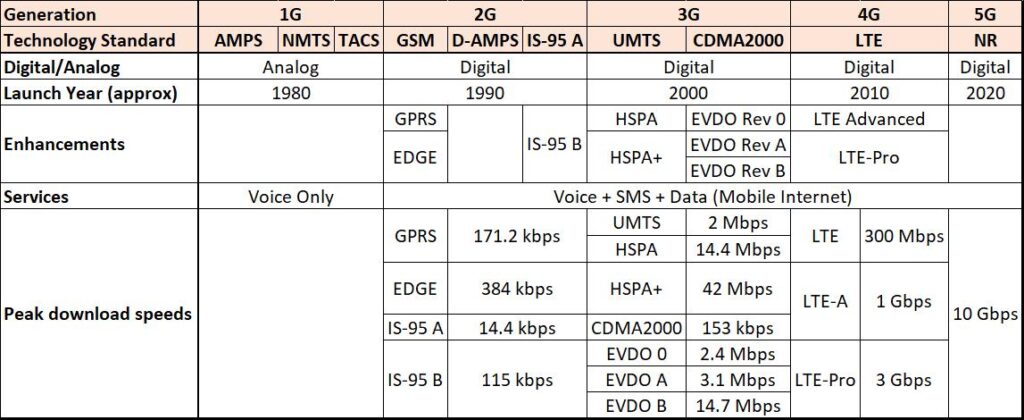
Cellular Technology Details
Fig. 1. Cellular Technology Details
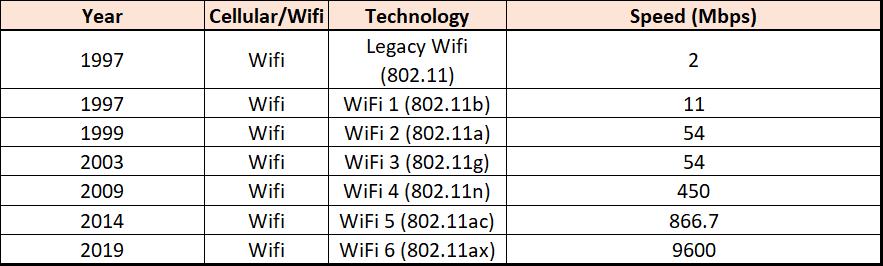
Wifi Technology Details
Fig. 2. Wifi Technology Details

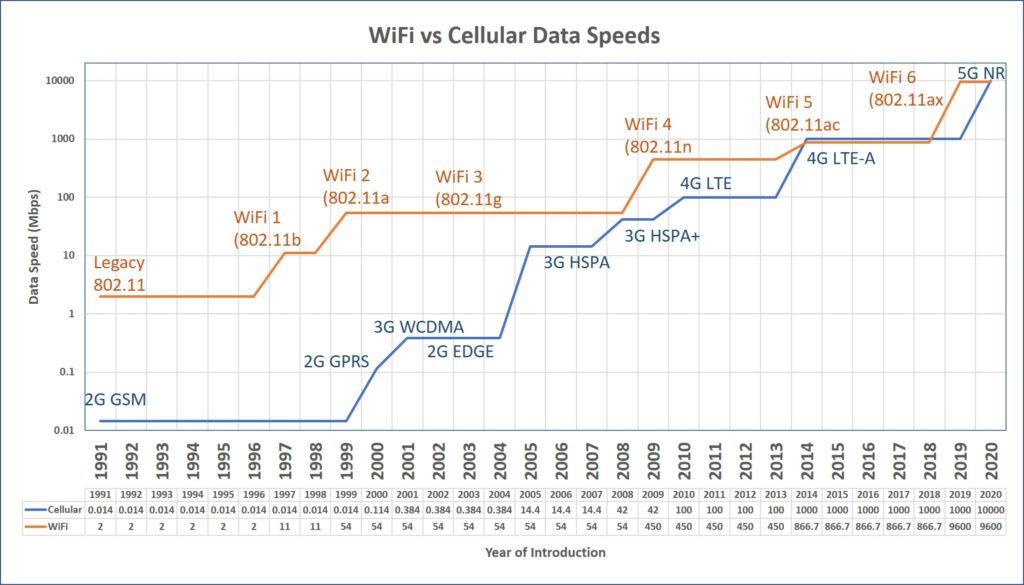
From the details above, it is clear that the data download speeds in 4G & 5G networks are touching Gbps (Billions of bits per second) rates, similar to the latest WiFi 5 & WiFi 6.

The below graph captures the data speeds in different Mobile and WiFi technologies, w.r.t. time of introduction of those technologies.

WiFi vs Cellular Download Speeds
Fig. 3. WiFi vs Cellular Comparative Download Speeds

We can observe from the above graph, that although WiFi data download speeds were significantly high earlier, the same are converging with the advancement of the technologies.

Yet, looking at the changing scenario, the perception that mobile networks are inferior to Wifi has still persisted.

In the changing scenario, there is a need to review the logic of whether the smartphones should still continue to have a one-way logic of switching over to the nearest WiFi if a usable WiFi is available.

Challenges in Deployment of Cellular vs WiFi Networks:

Setting up of both – the Cellular Networks, as well as WiFi, is much more complex than often it is portrayed as. A number of challenges pose while planning and deployment of these networks.

Let’s look at some of the common challenges, followed by some unique challenges, in the deployment of Cellular & WiFi networks:

Common Challenges:

 
Planning Stage:
  • Proper understanding of requirements & constraints:

A good network deployment starts with proper planning. Planning involves understanding the requirements and constraints and working out the most appropriate solution.

Formulating requirements is often overlooked or disregarded, because on the surface, requirements seem to be quite easy: Mobile or Wifi availability is a commodity, and it should be readily available flawlessly! Unfortunately, most customers and end-users don’t even have more than a passing knowledge of networking or information technology. Hence, they don’t appreciate what is possible vs impossible, or what is easy and cheap vs what is difficult and expensive.

  •  Proper product selection:

Picking the right solution and right product is very important to be able to compete in the highly competitive market. Technology is constantly evolving at a high pace. Choosing an established product today may be a wrong decision if it soon gets replaced with a new technology product with significantly higher features.

The Cellular telephony equipment are quite costly, and hence changing the products altogether will not be an easy affair. A feature in a new product may become a game-changer for one operator, but developing the same feature in existing equipment may incur a lot of time as well as costs, and at times it may not be feasible too.

In WiFi scenario, although the WiFi vendors and WiFi solutions are treated as interchangeable, however, the reality is that most network vendors have optimized their products and services to meet the typical requirements of specific vertical markets. Hence a solution tuned for one environment may be a very poor choice for another because the requirements are very different.

  • Network Coverage:

A well-designed network starts with an understanding of the physical layout and where exactly the coverage is required. This is often more efficiently done by using mapping tools such as Mapinfo or NetSpot, apart from physical site surveys. Several challenges such as the terrain, the buildings, and walls, impact the transmission of airwaves, thereby affecting the network coverage. It’s always much more efficient and cost-effective to properly map out your coverage from the beginning, rather than to go back and make changes once the network has already been installed.

  • Sufficient Capacity:

Once the desired coverage is determined, it’s important to plan the capacity of the network based on the expected behavior of the end-users who will be accessing it, such as the number of devices, type of devices, and how they will be using (e.g. frequency of usage, applications, etc.)

  • Integration with the existing network:

Another important aspect to be considered is how will the new node [Access Point (AP) or cellular node] be connected, and will it impact the coverage of other existing AP or node. A poorly planned AP/Node may create interference, which may adversely impact the customer’s experience. Moreover, they need to be planned with respect to their associated nodes in the hierarchy (which may involve evaluating the capacity, connectivity, and software versions of all associated nodes).

  • Future growth in customers/traffic:

A new node/AP is planned to be scalable so that it is able to cater to the requirements of existing and new customers in the changing scenario. The absence to consideration of this aspect may lead to challenges such as the degraded or interrupted experience of the customers.

  • Roaming

Mobile device users typically want to have mobility. So the network needs to allow users and their devices to move seamlessly from AP to AP or from a Cellular node’s coverage to another node’s coverage. The expectation nowadays is that a user can move from anyone point to another point in an office, college campus, restaurant, store, hospital, or any other place, without any disruptions to the applications they are running.

  • Network Security:

Each day, while the technology is evolving, the threats from hackers, viruses, malware, and other cyber-criminal elements are also rising. The network needs to be prevented from such unwanted disruptions, hence strong network security is essential for a smooth customer experience. Network security is always an ongoing challenge in such a dynamic scenario, and periodic actions need to be taken to ensure proper security of the network.

Deployment/Project Rollout:

The planning is followed by the deployment or project rollout stage. This is another challenging stage where a high level of coordination is required between different parties that are involved in different tasks. The timely deployment involves series of synchronized actions by various stakeholders.

  •  Procurement, Logistics, Warehousing, and Inventory Management:

Timely procurement of material for deployment is the first challenge to the success of this stage. It involves vendor finalization, negotiating, and optimizing lead times for procurement, logistics, warehousing, and transit to the deployment site. Necessary safety & security measures to ensure damage-free material delivery are also important.

  • Site Preparations:

On-site readiness in terms of legal contracts, space, power, connectivity, etc. is required to be done before the actual equipment reaches so that the idle time of the equipment is minimal.

  • Deployment Team:

The deployment teams should be aligned as per the readiness of the site and the equipment. At times the challenges may be posed due to insufficient skills of the deployment team, or human resource issues as well.

  • Alignment with teams handling associated nodes:

The cellular nodes or AP’s may need to be connected with other nodes, for which synchronized actions are required by other teams as well. Necessary alignment with such teams is important to ensure timely and smooth implementation of the new network nodes.

  • Troubleshooting of issues:

 Sometimes, the new nodes do not function properly after they have been installed and configured. This requires them to be troubleshot to find and resolve the issues. The known issues may be immediately resolved, but some issues may lead to significant time in resolution, which can delay the deployment.

  • Acceptance Testing and Go-live:

At this time, the deployed equipment is tested for its proper installation & functionality. Challenges in the form of inferior-quality installation, abnormal or inconsistent observations of tested results in its functionality, etc. can be observed at this stage, which is resolved by the deployment team.

Once the Acceptance Testing is completed, the node is declared as go-live and goes into normal operations mode.

Operations:

Once the network is made on-air, any operational issues are dealt with to ensure optimum performance.

  • Network Availability:

After the network is made on-air, if the services get disrupted due to any reason (power failure, hardware or software issue, connectivity failure, etc), the customers may get impacted. Think about a person in emergency wanting to make a call, or a businessman wanting to transfer funds urgently for a critical time-bound financial deal. Networks are generally designed to have high availability, with necessary redundancy in the hardware and connectivity. Moreover, the operations teams carry out preventive maintenance activities at regular frequencies, to ensure smooth functioning of the deployed network.

  • Network Optimization:

Due to the dynamic nature of the customer’s behavior, as well as with the changing demographics or natural reasons, the network coverage or capacity may not be sufficient to cater to the new scenario. In such cases, network optimization may be required, which may involve activities such as change of antenna orientation, capacity increment/decrement, feature changes, etc. Performance monitoring is necessary to keep track of the network behavior and statistics and take necessary optimization actions if required.

  • Cost:

Optimizing the costs in deployment and operations of the network is another important challenge. After all, the cost versus revenues is important with any business. Hence, the network owners constantly look for ways to optimize the cost of network deployment and operations.

Unique Challenges:
  • Installation Challenges:

The typical range of WiFi is less, and is generally designed to cover a premise such as a railway station, airport, mall, hotel, etc. While the customers may demand a good network in every nook and corner of the premises, they don’t want the access points or cabling visible to avoid damage to the aesthetics.

The mobile customers also demand proper coverage, however, at some of the places, they don’t want to have mobile towers or antennae due to the concern of radiation and health issues.

  • Spectrum / Frequency Bands:

While the mobile operators are generally bound by their agreements to use the licensed spectrum for cellular mobile operations, WiFi operators can utilize the unlicensed frequency bands of 2.4 GHz and 5 GHz.

For offering cellular services, the mobile operators need to purchase the spectrum from the regulator at a price, which is generally high. In India, the mobile operators have been allocated the frequencies in the bands of 900 MHz, 1800 MHz, 2100 MHz, 850 MHz, 2300 MHz, 2500 MHz, which they have mostly procured through Spectrum Auctions. On the other hand, the WiFi spectrum is inexpensive as it is from unlicensed bands.

  • Roaming & Handoffs:

As WiFi clients move in the network, the signal strength from different WiFi APs constantly changes. Because clients are making the decision on the best AP to connect to at any given time, consistent connectivity and reliable performance become a major issue due to inconsistent implementations by different device vendors.

With cellular wireless, roaming and handoffs between access points are coordinated and controlled by the network infrastructure. As devices move throughout the network, they report channel quality to their serving APs. The network infrastructure decides exactly when to perform handover from one AP to another AP to ensure no loss of connectivity or any data providing a consistent and uninterrupted user experience.

  • Cost and Range of Products:

While the number of mobile vendors is comparatively less as compared to those of WiFi vendors, the mobile products are also comparatively costlier as compared to WiFi equipment. Hence owning and using WiFi is generally cheaper than mobile data.

Conclusion:

While many of the challenges are similar in WiFi and Cellular deployments, there are some unique challenges and requirements as well in each type of network deployments. It is more about how you plan your approach and address those challenges. Both these technologies will closely intertwine to provide a better experience to the customers.